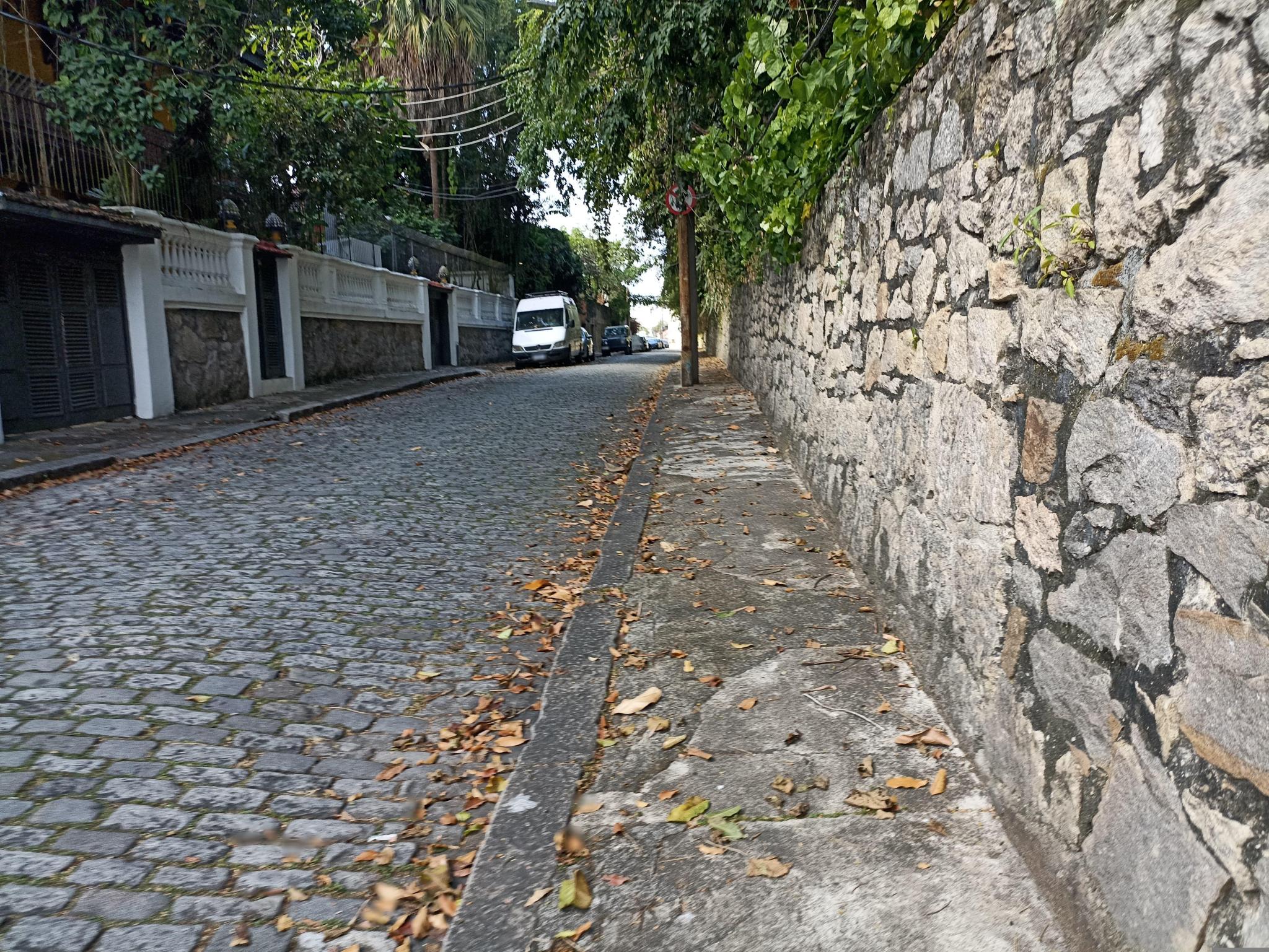
Lush tropical canopy: Palms, vines and dense evergreen trees point to a humid tropical coast.
Rough granite retaining wall: Grey granite walls on steep hills are typical of Rio's hillside neighbourhoods.
The first thing that jumps out is the road surface: chunky grey granite blocks laid in rows, with moss in the gaps. That alone leans Brazil, where these setts are everywhere in older districts. Then the greenery seals the climate: palms, hanging vines and broadleaf trees mean humid tropics, which rules out Portugal and most of Europe despite the colonial balustrades. The steep slope and the rough grey granite wall fit Rio's hilly neighbourhoods, built right against granite mountains. A habit worth carrying: in Brazil, cables strung messily across the street and plain prohibition signs on wooden or concrete poles are common, so combine them with paving and vegetation before committing.
Easily confused with
Lisbon, Portugal: Lisbon lacks this jungle-like growth and has smaller limestone cobbles.
Cartagena, Colombia: Cartagena's old streets are flat, bright colonial facades, not granite hillside walls.
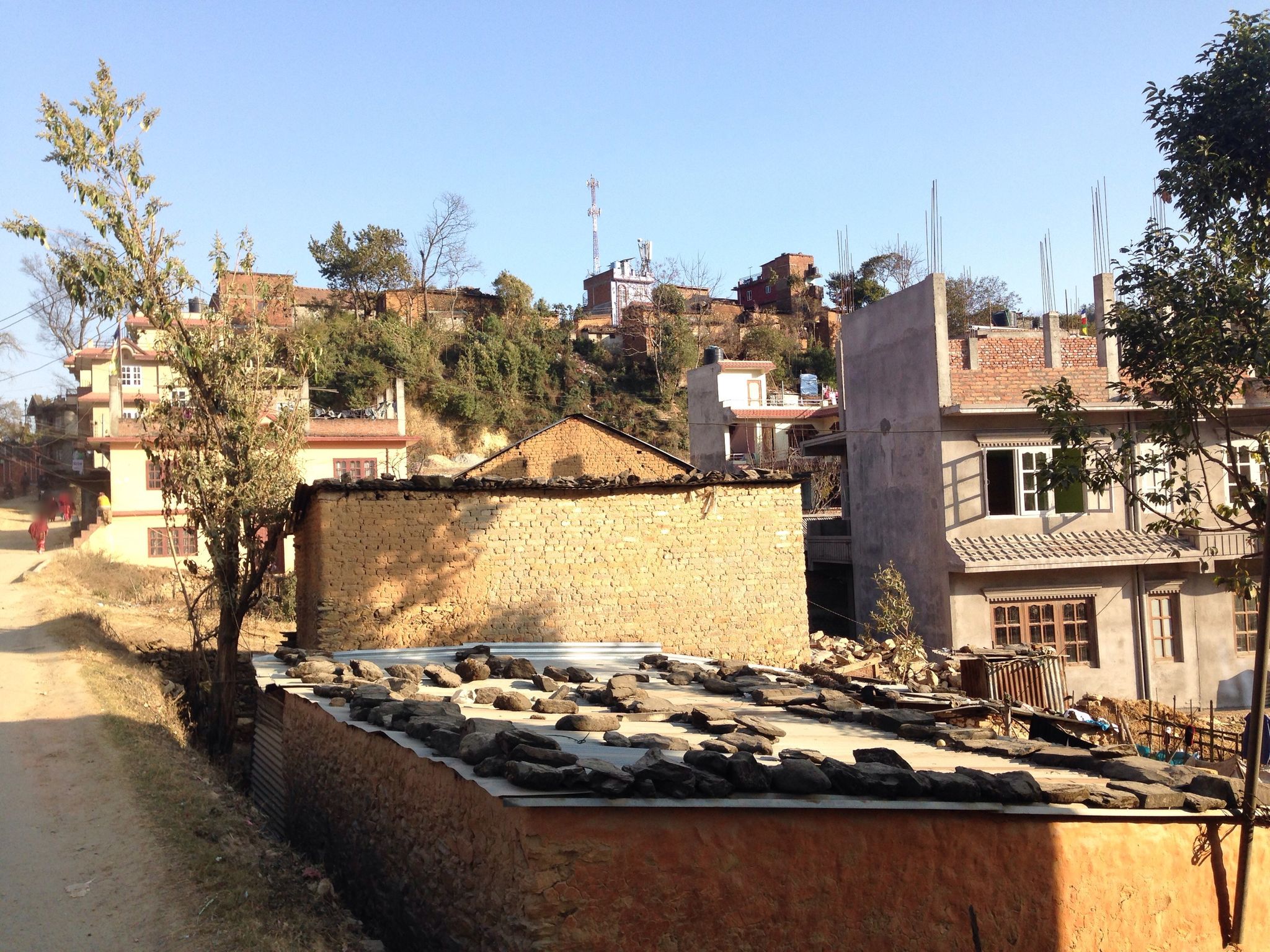
Rebar sticking from rooftops: Unfinished concrete houses with steel rods left for future floors are classic Nepal and South Asia.
Carved wooden window frames: Dark wood windows on pastel concrete houses point to Nepal's Kathmandu Valley style.
Stones weighing down tin roof: Corrugated sheets held by rocks suggests post-2015-earthquake rebuilding in Nepal's hills.
First thing that jumps out is the rebar poking up from flat roofs, the steel left so another floor can be added later. That alone puts you in South Asia. Then the mix: old mud-and-stone houses beside pastel concrete boxes with dark carved wooden windows, a very Nepali combination. Tin roofs weighed down with rocks and piles of rubble hint at rebuilding after the 2015 earthquake, which hit Bagamati hardest. The dry winter hillside, dirt lane and a faint prayer flag on a rooftop fit the middle hills near Kathmandu. Carry this forward: in Nepal, look for brick-red or pastel houses stacked on steep slopes, black water tanks on roofs, and dense overhead wires.
Easily confused with
Northern India (Uttarakhand, Himachal): Nepal favours pastel multi-storey boxes with carved wood windows and prayer flags.
Bhutan: Bhutan houses have painted wooden eaves and strict traditional facades, not bare concrete.
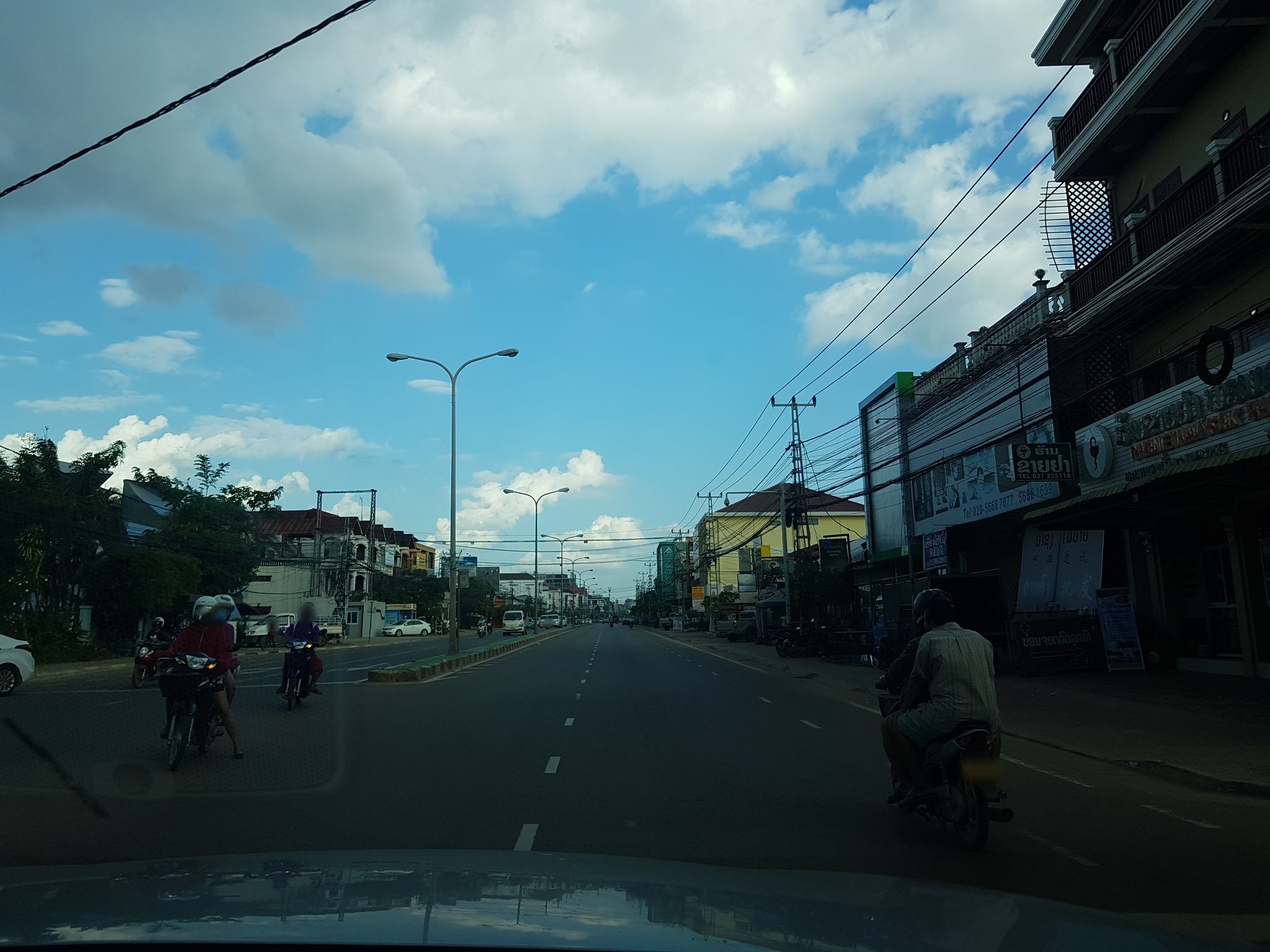
Lao script on signs: Rounder, simpler letters than Thai, with fewer loops and no Thai-style serifs; this is Lao.
Phone numbers 020 and 021: 020 is Lao mobile and 021 is the Vientiane area code.
Right-hand traffic: Driving on the right rules out Thailand, which drives on the left.
The first thing to check is which side the traffic uses: motorbikes and the car keep right, which immediately kills Thailand despite the signs looking Thai at a glance. Then read the shopfronts closely; the letters are rounder and less ornate, which is Lao. The phone number starting 021 is a gift, since that prefix belongs to the capital region, while 020 numbers are Lao mobiles. A wide divided boulevard with double-armed streetlights, tangled overhead cables on concrete poles and three-storey shophouses fits a mid-sized Southeast Asian capital. Carry this to other rounds: Laos has few big cities, so any urban, multi-lane scene in Laos is very likely Vientiane.
Easily confused with
Thailand: Thailand drives on the left; Lao letters look rounder and plainer.
Cambodia: Khmer script is spikier and denser, with stacked letters.
Remember: Thai-looking script plus right-hand driving usually means Laos.
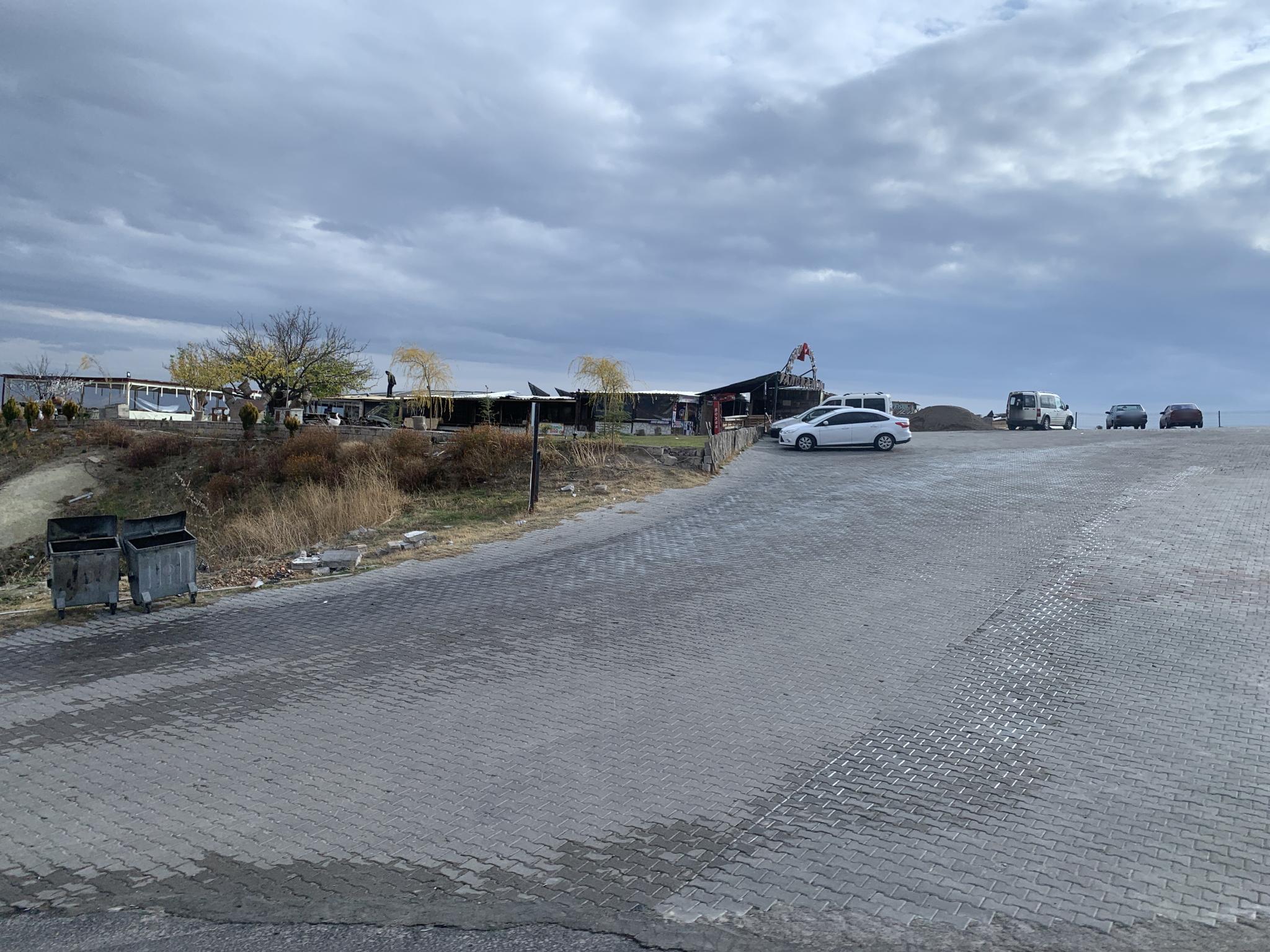
Grey interlocking paving stones: Turkish towns pave side roads and car parks with these concrete blocks instead of asphalt.
Galvanised wheeled dumpsters: Grey metal bins with lids on wheels are a common Turkish municipal sight.
Ford Connect van, old sedans: Boxy white Ford Connect vans and older Tofaş sedans fill Turkish roads.
The ground gives this one away first: a whole slope laid in grey interlocking concrete blocks, the kind Turkish municipalities put on almost every side street, car park and village lane. Next, the two galvanised dumpsters on wheels and the white Ford Connect van, a vehicle Turkey builds and drives in huge numbers. Dry tussock grass, bare earth and yellowing willows point to a high, dry plateau rather than the green Black Sea coast or the Mediterranean south, which fits the Anatolian interior. That rules out the Balkans' greener hills and Iran's different script and cars. A habit worth keeping: in Turkey, when you see block paving and few road markings, look at the vehicles and bins before hunting for signs.
Easily confused with
Iran: Iran shows Persian script and Iranian-built Peugeots, not Ford Connect vans.
Inland Spain: Spain uses asphalt and green plastic bins, not grey block paving.
Remember: Grey block paving plus metal wheeled bins usually means Turkey.
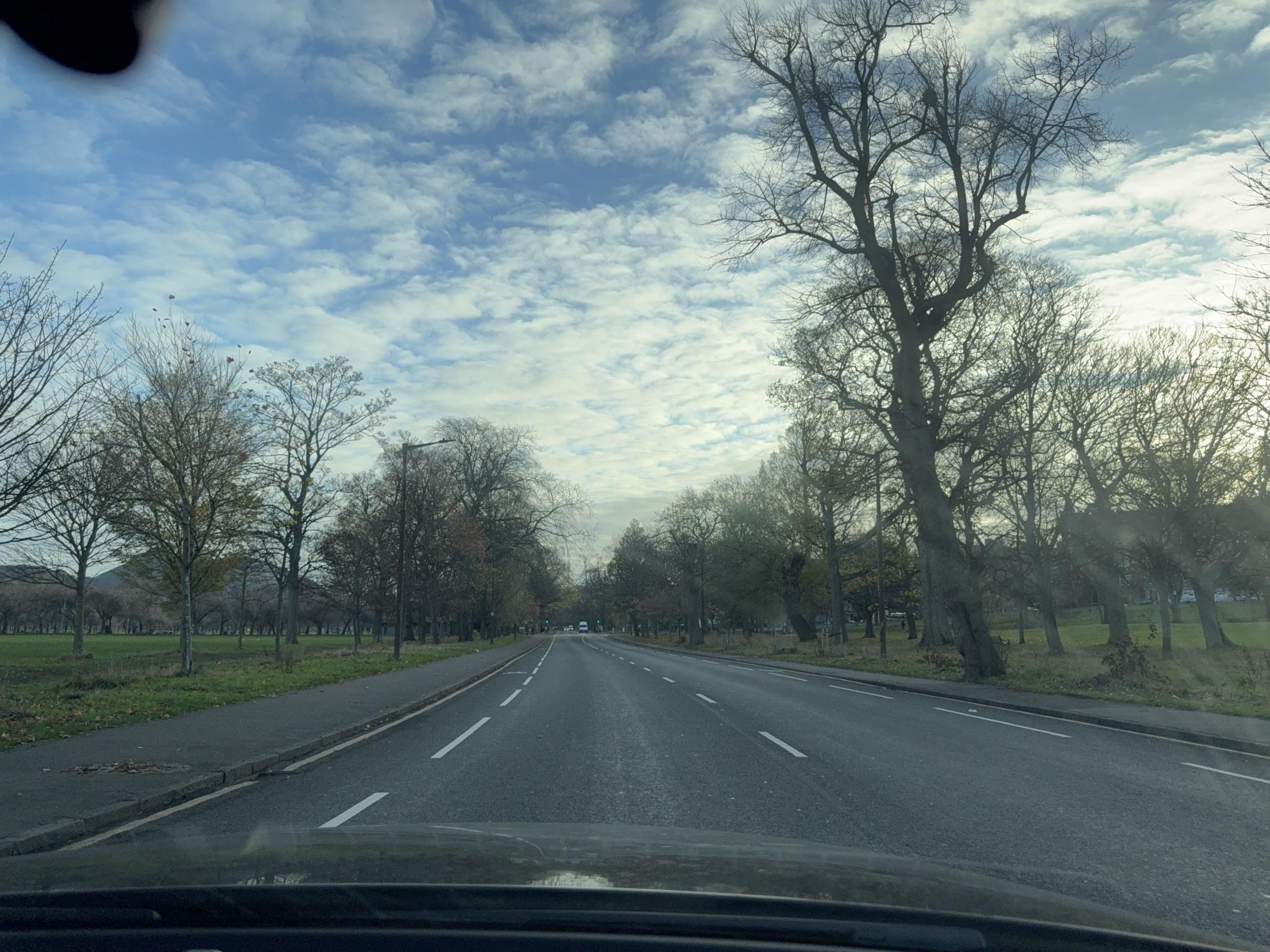
Driving on the left: The car keeps left with oncoming lanes on the right, pointing to Britain or Ireland.
White dashed lane lines: Short white dashes and white kerb lines match standard British road markings.
Rugged hill beyond park: A craggy hill rising beside a flat city park suggests Edinburgh's volcanic landscape.
First thing: the car sits in the left lane with traffic lanes opening on the right, so you're in left-driving territory, and the plain white dashes and kerb lines narrow that to Britain fast. Bare deciduous trees over still-green grass say a mild, damp autumn, which fits the whole UK. The decider is that dark, lumpy hill peeking out beyond the open park on the left: a rough volcanic crag sitting right next to a flat city green is very Edinburgh. Carry this to other rounds: Scottish cities often have hills or crags visible from ordinary streets, while much of lowland England looks flatter and gentler behind the trees.
Easily confused with
Northern England: A rocky crag right beside the city points north to Scotland.
Ireland: Irish road edges often use yellow lines; these are white.
Remember: Left driving plus white dashed lines and a crag hints Scotland.
 dropzone
 13